TL;DR Include the word “interdisciplinary” and you should be fine 🙂
It can be a bit tricky to know exactly what the IB want from a World Studies essay as you try to balance two subjects at once. Thankfully there are some things that are almost always loved by examiners and supervisors alike and this guide will tell you all about them 🙂
The guide will try to be generalised, but my topic was essentially changing diets and how that’s causing different problems in different communities if you’re interested. I’ll be quoting from my EE and make references to the IB rubric throughout.
Introduction and Research Question
There’s plenty of advice about choosing a good and specific RQ out there. The main things you should keep in mind are that you will need to perform some sort of actual statistical test (like Spearman’s) so if you can somehow manipulate continuous data into your RQ or the methodology used to answer it, you’ll be golden. My RQ roughly follows the lines of “How has X changed for these local case studies (the geography bit) and how will this affect their health (the biology bit)”.
Here’s what you should do in the intro:
1) Say what your case studies and global theme are e.g. Health and Development
2) What will your findings show/help with
3) Explain a brief bit of the background theory if it’s a more complicated topic
4) Explain why you need to use an interdisciplinary approach
Using an interdisciplinary approach is crucial for this investigation because I need to use Geography to gain an appreciation and understanding of why this transition is happening on global and local scales, but also need Biology to gain an appreciation of what consequences an uncontrolled transition may have on the health of those experiencing it.
5) You can also throw in how you selected data for your case studies if relevant
6) Geography-focused EEs need MAPS – get some maps and highlight the local case studies you’re focusing on them and make them big (at least half a page).

The Biology Bit
Include a few pages about the biological theory. You don’t need to go super in depth. If your topic aligns closely with something on Bioninja then you can use that as the basis of the actual theory and the rest of the section can put into context how big of a problem this is in your case studies, but also globally.
Changes in nutrition can have significant knock-on consequences to health. The multifaceted nature of diet means someone with malnutrition could have anything from low zinc to excessive caloric intake – many of these are diet-induced risk factors for certain diseases. These risk factors have some of the greatest effects on disease-adjusted life years (DALYs) (Afshin et al., 2019).
What will apply to both the biology and geography bit is using the same sort of languages they use in textbooks like “demographic transition” and “epidemiology”.
‘The use of subject-specific terminology and concepts is accurate and consistent, demonstrating effective knowledge and understanding.’
The Geography Bit
Unfortunately, there’s no GeographyNinja yet. On the bright side, you can again explain the geographical theory with what you’ve learned in class. I just talked about globalisation and urbanisation ultimately leading to the boom in accessibility of processed foods and thus the boom in obesity (with recognition of a whole bunch of other factors, of course).
I would suggest that if you’re listing factors that you focus on e.g. three and explain them quite rigourously. The IB’s critical thinking criteria will favour you if you try and explain which one of the factors you think is actually the main driving force.
Of these three factors, I think globalisation has the greatest effect on the indigenous communities in terms of increasing the consumption of processed/nontraditional foods. This is because, although the diets of indigenous communities have changed significantly, their average per capita GDPs have not increased to an extent even broadly comparable to other, larger countries like India and China over the previous decades and urbanisation as a cause for transition is inevitablylinked to supermarket accessibility and, thus, globalisation. I decided to investigate the link between nutrition transition and globalisation farther
Linking the Biology and Geography, Statistically
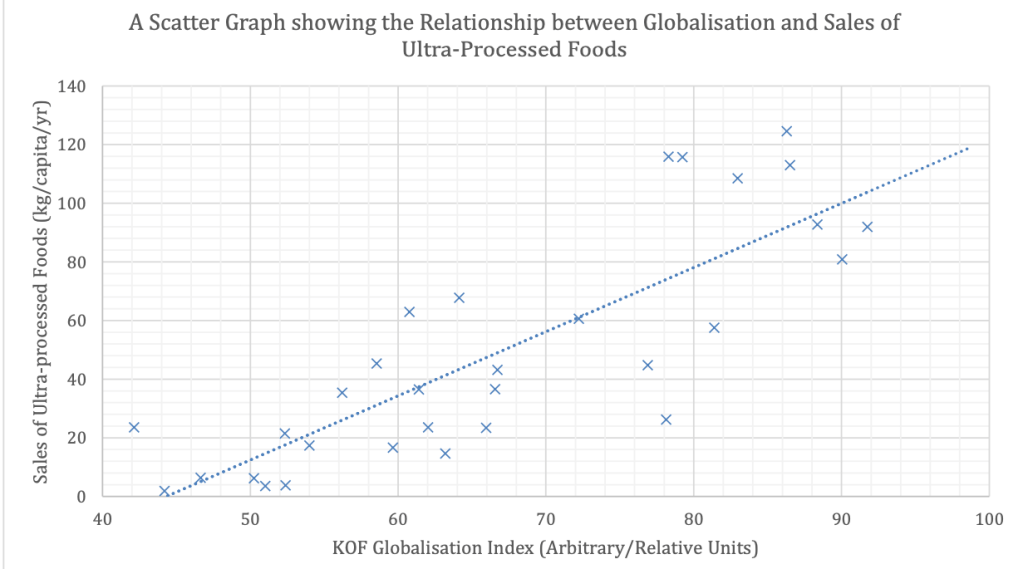
It’s not explicitly stated in the marking rubric, but you need some sort of statistical analysis (i.e. not just bar graphs and pie charts). My way of doing this was just finding two variables that corresponded to each of my topics (globalisation with Geography and processed food sales with Biology), getting secondary data from it online and then presenting a scatter graph with a worked example of Spearman’s.
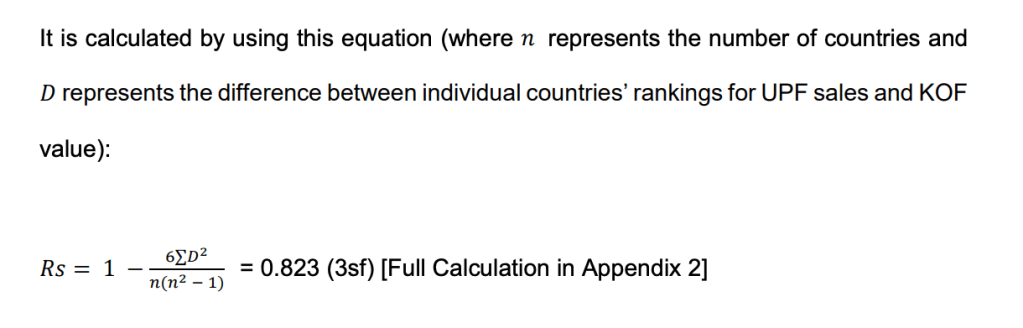
Remember to say correlation isn’t causation and you’re golden.
Case Studies – The Nitty Gritty
Next up comes the part where you delve into your case studies. Most likely the data you presented in the section above won’t fully help you answer your research question and there’s more data to talk about in this section.
A word on selection of case studies is that you should prioritise not the ones that look cool and easy to talk about, but the ones that have lots of data and information about them.
Generally, I introduced what life was like in the communities of my case studies in the past and how its changing over time with specific mentions of the foodstuffs they consume(d). I backed all of this up with data I essentially found from two or three studies that let me generate pretty pie charts and bar graphs.
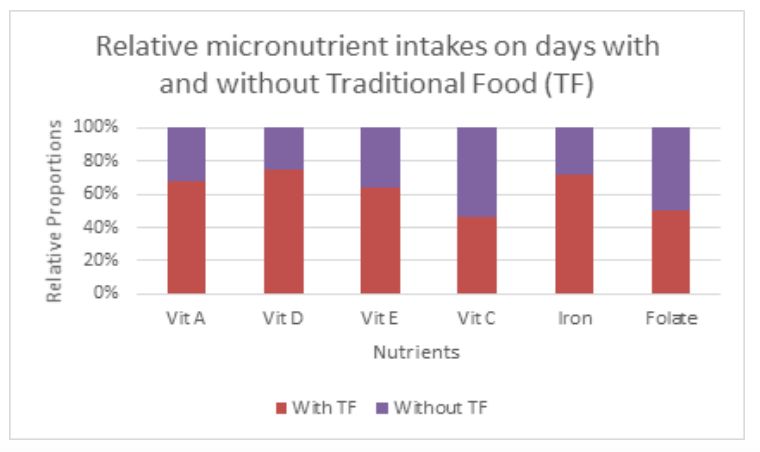
The next bit is to compare and contrast your case studies. What do they share in the data? Where do they differ? Why do they do so? Of course, it can be pretty useful to look at analogous data rather than exact similarities, as your two or whatever number of communities halfway across the world from each other are unlikely to both eat Cheetos, for example.
What people have traditionally eaten for hundreds of years is beginning to change within these communities. Traditional foods are slowly being replaced by processed foods, often with less nutrients and protein but more refined sugar and saturated fat. This has predictably had a consequence on health – highlighted by surges in obesity rates e.g. in
American Samoa (What we know about overweight & obesity in American Samoa, n.d.).There are some remarkable similarities between the case studies: both still incorporate elements of the traditional diet that has been passed on intergenerationally, though sugar, white bread & butter are frequently new additions to the typical indigenous diet…
Evaluating the Data
This is more so important for primary data, but also helpful to show you’ve thought critically about secondary data if you have it. You can pretty much always talk about sample size and biases due to the timing/subjectivity/duration of the studies.
Future Suggestions/Recommendations
As you’ve probably done in the long answer Geography questions that come up in exam papers, it’s vital to mention and suggest what might happen in the future. An angle you can pretty much always take will be Covid and the effects of the pandemic – how does that effect the topic you’ve explored?
If applicable, highlight some strategies that have already been implemented elsewhere in the world and then evaluate whether they would be likely to work in the case studies you explored specifically. If not, then come up with some suggestions or what might happen in the future if the problem goes unresolved.
When in doubt, mention that education is the answer.
The global climate has changed drastically since the time of the studies used in this investigation – the shrinking world has meant the importation of foodstuffs has become even easier due to a reduced ‘friction of distance’. In short, the world has become more globalised. However, the impacts of CoVID-19 may partially reverse this, so it would be interesting to research in the future how diets have changed as a result and whether diets have become more or less reliant on supermarket-bought UPFs.
Conclusion
Explain that your investigation was useful and re-iterate the usefulness of taking an interdisciplinary approach to this topic.
This exploration into Nutrition Transition within indigenous communities has been valuable – allowing me to explore not only the global issue of increasing consumption of processed and ultra-processed foods around the world, but also apply it to a more localscale focusing on two specific communities. The interdisciplinary approach taken was effective in interpreting the Biology of the consequences or potential benefits of the
change occurring and the Geography of why such transition is occurring and will continue to do so.
A Few Words on Presentation
Double spacing (I think). Page numbers. Bibliography with (something like this, 2022) in the text itself and the full shazam at the end. Make all the graphics and data big and readable. If you want to use abbreviations like HDI, you must first introduce it in full i.e. Human Development Index, or HDI…


 Bavesh Blogs
Leave a comment